
The artificial intelligence landscape is experiencing an unprecedented transformation, and at the heart of this revolution are generative AI experts—the visionaries and technical specialists who are redefining how we interact with intelligent systems. These professionals are not just building the next generation of AI tools; they’re fundamentally changing how businesses operate, how creative content is produced, and how human potential is amplified through machine intelligence.
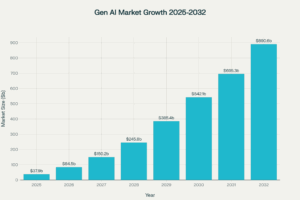
The generative AI market has exploded into a $37.9 billion industry in 2025, with projections showing it will reach an astounding $1 trillion by 2034. This represents a compound annual growth rate of 44.2%, making it one of the fastest-growing technology sectors in history. Behind these numbers are generative AI experts who are pushing the boundaries of what’s possible with machine learning, natural language processing, and creative AI systems.
Generative AI Market Growth Projection (2025-2032)
These experts are driving innovation across multiple fronts. According to Stanford’s AI Index Report, generative AI attracted $33.9 billion in private investment globally in 2024, representing an 18.7% increase from the previous year. This massive investment reflects the confidence that business leaders have in generative AI experts to deliver transformative solutions.
Generative AI experts serve as the bridge between cutting-edge research and practical business applications. Their work encompasses several critical areas:
These professionals design and implement AI strategies that align with business objectives. They analyze organizational needs, identify opportunities for AI integration, and develop roadmaps for successful adoption. McKinsey research indicates that generative AI could contribute between $2.6 trillion to $4.4 trillion in value across industries annually.
Generative AI experts build sophisticated systems using advanced architectures like transformers, diffusion models, and generative adversarial networks (GANs). Their technical expertise enables the creation of AI systems that can generate human-like text, create realistic images, compose music, and even write code.
The versatility of generative AI has led to its adoption across diverse sectors. Gartner predicts that by 2025, marketing professionals will use generative AI to create 30% of outbound marketing materials. Similarly, in healthcare, AI experts are developing diagnostic tools and personalized treatment plans that could revolutionize patient care.
The impact of generative AI experts extends across virtually every major industry sector. Their work is creating new possibilities and transforming traditional business processes:
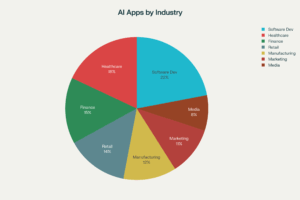
Generative AI Applications Distribution Across Industries
Generative AI experts in healthcare are developing systems for drug discovery, medical imaging analysis, and personalized treatment recommendations. These applications can reduce drug development timelines from decades to years and improve diagnostic accuracy significantly.
In finance, AI experts are creating sophisticated fraud detection systems, automated report generation tools, and personalized financial advisory platforms. Indian banking industry productivity could increase by 46% by 2030 through generative AI implementation.
Manufacturing benefits from AI-powered predictive maintenance, quality control systems, and automated design optimization. Generative AI experts are helping companies reduce downtime, improve product quality, and accelerate innovation cycles.
Perhaps nowhere is the impact more immediate than in software development. Generative AI experts have created tools that can generate code, automate testing, and assist developers in building applications faster than ever before. Software development represents 22% of all generative AI applications across industries.
The current AI revolution is characterized by several key trends that generative AI experts are pioneering:
Generative AI experts are making advanced AI capabilities accessible to non-technical users through intuitive interfaces and pre-trained models. This democratization allows businesses of all sizes to leverage AI without requiring extensive technical expertise.
Today’s generative AI experts are building systems that can process and generate multiple types of content simultaneously, text, images, audio, and video. These multimodal capabilities open up entirely new possibilities for human-AI collaboration.
As AI becomes more powerful, generative AI experts are increasingly focused on developing responsible AI systems. They’re addressing challenges related to bias, privacy, and the potential misuse of AI-generated content.
The most effective generative AI experts combine deep technical knowledge with strong business acumen. India needs at least 1 million skilled AI professionals by 2026, creating unprecedented opportunities for those with the right expertise.
Key competencies include:
The work of generative AI experts is creating measurable business impact across sectors. Nearly 80% of companies report using generative AI, though many are still working to maximize its bottom-line impact. This presents both opportunities and challenges for AI experts who must deliver not just technical excellence but also clear business value.
The demand for generative AI expertise continues to surge. Unique job postings for generative AI skills have grown from 55 in January 2021 to nearly 10,000 by May 2025. Major companies including Amazon, Accenture, Deloitte, Meta, and Google are leading hiring efforts, indicating strong corporate commitment to AI transformation.
Generative AI experts are the architects of our AI-driven future. Their work is not just about building better algorithms or more sophisticated models; they’re reshaping entire industries, creating new forms of human-AI collaboration, and solving some of the world’s most complex challenges.
As the generative AI market continues its exponential growth trajectory, these experts will play an increasingly critical role in determining how AI technologies are developed, deployed, and integrated into society. Their expertise ensures that the AI revolution delivers not just technological advancement but meaningful human benefit.
For organizations looking to harness the power of generative AI, partnering with skilled experts is essential. Workflexi connects businesses with top-tier generative AI professionals who can drive innovation, deliver results, and help navigate the rapidly evolving AI landscape.
Generative AI experts are specialized professionals who design, develop, and implement AI systems capable of creating new content like text, images, code, and media. They combine deep technical knowledge with business strategy to deliver transformative AI solutions across industries.
They’re driving innovation by creating accessible AI tools, developing multimodal systems, and implementing AI solutions across healthcare, finance, manufacturing, and software development. Their work has generated $33.9 billion in investment and created nearly 10,000 new job opportunities.
Software development (22%), healthcare (18%), financial services (15%), manufacturing (12%), and retail/e-commerce (14%) are the most impacted sectors. These industries are leveraging AI for code generation, diagnostics, fraud detection, and personalized customer experiences.
Essential skills include advanced machine learning knowledge, programming expertise in Python and AI frameworks, domain-specific knowledge, ethical AI principles, and business strategy capabilities. The field requires both technical depth and practical application abilities.
Generative AI is democratizing AI capabilities, enabling multimodal content creation, and accelerating business transformation. The market is growing at 44.2% CAGR and is projected to reach $1 trillion by 2034, driven by expert innovation.
Applications include drug discovery in healthcare, automated code generation in software development, fraud detection in finance, predictive maintenance in manufacturing, and content creation in marketing. These applications deliver measurable ROI and operational efficiency.
Businesses gain competitive advantages through faster product development, improved customer experiences, cost reduction, and process automation. McKinsey estimates generative AI could contribute $2.6-4.4 trillion in annual value across industries.
The future involves increased integration across all business functions, more sophisticated multimodal AI systems, and stronger focus on ethical AI development. With 80% of companies already using generative AI, experts will be crucial for maximizing business impact and ensuring responsible implementation.
Why Take Up Gigs/Part-time Jobs Alongside Your Full-time Job? The job market is constantly changing and evolving. People are prioritizing their financial stability and independence over everything. The previous culture of hustling and putting in more and more hours every…

A prompt engineer expert should understand prompt design, context management, output formatting, testing and evaluation, task decomposition, and the limitations of different AI models. They should also know basic API and tool-calling concepts so prompts can be used in automated…

A machine learning expert should know Python, core statistics, machine learning algorithms, data preparation, and model evaluation. Framework knowledge TensorFlow, PyTorch, or Scikit-learn depends on whether the project needs deep learning or simpler, structured-data models. No single tool defines expertise;…

AI is changing freelance data analyst work by automating repetitive tasks like data cleaning, SQL query writing, and first-draft reporting, while increasing the value of skills AI can't easily replicate business context, data validation, and client communication. AI is unlikely…