If you are exploring artificial intelligence for your business in 2026, you will likely come across two critical services: AI Consulting and AI Development. While they sound similar, they serve very different purposes. AI Consulting is the “what” and “why”, a strategic service that plans the roadmap, while AI Development is the “how”, the technical building of the actual software and models. Understanding this difference is crucial to budgeting correctly and achieving a return on your investment.
Simultaneously, global AI investment (including development) is expected to soar from $315.9 billion in 2024 to over $1.2 trillion by 2029 . This surge indicates that businesses are not just planning AI (consulting) but are heavily building AI (development).
AI Consulting is an advisory service focused on business strategy, opportunity identification, and risk management. An AI consultant acts as a bridge between complex technology and business goals. They do not typically write the final code for a product; instead, they analyze your current operations, data infrastructure, and market position to recommend where AI can drive value.
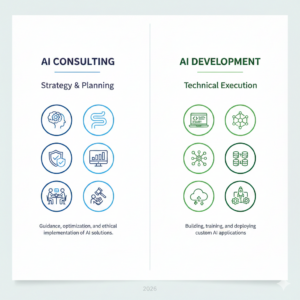
Strategic Roadmapping: Identifying high-impact use cases (e.g., automating customer service or improving supply chain forecasting).
Feasibility Studies: Assessing if your current data is “clean” enough and if the technology is mature for your specific problem.
Vendor Selection: Helping you decide whether to build a custom solution, buy an off-the-shelf product, or partner with a specific platform like Google Cloud or AWS .
Change Management: Preparing your team and processes for the integration of AI.
Ethics and Compliance: Ensuring the AI strategy adheres to regulations like GDPR or emerging AI safety standards .
AI Development is the technical execution of the consultant’s vision. This involves data scientists, machine learning engineers, and software developers who build, train, deploy, and maintain the AI systems. They work with programming languages like Python and frameworks such as TensorFlow or PyTorch to create functional models .
Data Engineering: Collecting, cleaning, and structuring massive datasets required for training.
Model Building: Selecting the right algorithms and training machine learning models or integrating Large Language Models (LLMs).
Software Integration: Embedding the AI model into your existing applications (e.g., adding a chatbot to your website or an AI agent to your ERP system) .
Testing & Maintenance: Continuously monitoring the model for “drift” (where accuracy degrades over time) and retraining it as needed.
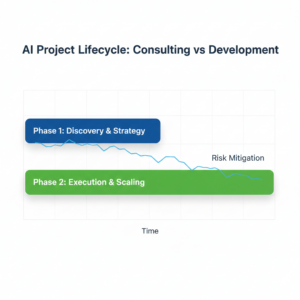
The difference often comes down to strategy versus execution. You need a consultant when you are unsure where to start. You need a developer when you have a blueprint and need a working product.
For example, a logistics company in India looking to optimize delivery routes would first hire an AI consultant to analyze their data and confirm that AI can genuinely reduce fuel costs. The consultant would create a specification document. Only then would they hire an AI development team to build a custom route-optimization engine using real-time traffic data and machine learning .
In 2025, we saw a major shift where consulting firms began acting more like developers. “Big Four” firms like Deloitte and EY are now heavily investing in “agentic” AI platforms, essentially building software for clients rather than just advising them. EY has already advanced over 1,000 AI agents into development, with plans to scale to 100,000 by 2028 .
Choosing the right service depends on your company’s maturity.
You need an AI Consultant if: You have a vague idea that “AI could help us,” but you don’t know the specific use case, the data requirements, or the potential risks. They help you avoid the “shiny object” syndrome and focus on practical applications .
You need an AI Developer if: You already know exactly what you want to build. You have a requirements document, you have access to the necessary data, and you are ready to create a minimum viable product (MVP). For instance, retailers like Mercari are using developers to build AI agents that handle customer service, anticipating a 500% ROI on those projects .
You need Both if: You want to go from zero to launch efficiently. The consultant ensures you are building the right thing, and the developer ensures it is built the right way.
In the rapidly evolving AI landscape of 2026, the line between consulting and development is blurring, yet the distinction remains vital. Consulting provides the compass, and development builds the ship. Whether you are a startup or a multinational corporation, starting with strategy prevents you from wasting millions on building the wrong solution. As AI agents become mainstream, businesses that master both the strategic planning and the technical execution will be the ones leading their markets .

Yes, many full-service digital agencies and large firms like Accenture or TCS offer both. However, it is common for boutique consulting firms to focus only on strategy, passing the technical development to specialized partners .
No. Small and medium businesses (SMBs) in India and the USA are increasingly using AI consultants to navigate the crowded tech landscape. Consultants help SMBs find affordable, scalable solutions rather than expensive custom builds .
Generally, consultants may have a higher hourly rate due to their strategic experience, but their engagement is shorter. Development costs have a wider range and are usually higher overall because they involve building the actual product, which requires more man-hours and infrastructure .
The typical outcome is a detailed roadmap or a Proof of Concept (POC). This document outlines the data needed, the technology stack recommended, and the specific business metrics the AI solution should improve .
Yes, often. An in-house IT team understands your current systems, but they may lack the specialized knowledge of emerging AI trends, ethical implications, or industry-specific AI use cases that a consultant provides .
An AI agent is an autonomous system that performs tasks (like a virtual employee). This relates to development, as agents are built by engineers. However, a consultant would advise on where to deploy these agents (e.g., in finance for reconciliation or in HR for onboarding) to get the best ROI .
The market is robust. While the US leads with over 55% market share, regions like Asia-Pacific, driven by India and China, are seeing massive growth rates. The focus has shifted from just building models to building infrastructure and “agentic” systems that do complex tasks .
Why Take Up Gigs/Part-time Jobs Alongside Your Full-time Job? The job market is constantly changing and evolving. People are prioritizing their financial stability and independence over everything. The previous culture of hustling and putting in more and more hours every…

A prompt engineer expert should understand prompt design, context management, output formatting, testing and evaluation, task decomposition, and the limitations of different AI models. They should also know basic API and tool-calling concepts so prompts can be used in automated…

A machine learning expert should know Python, core statistics, machine learning algorithms, data preparation, and model evaluation. Framework knowledge TensorFlow, PyTorch, or Scikit-learn depends on whether the project needs deep learning or simpler, structured-data models. No single tool defines expertise;…

AI is changing freelance data analyst work by automating repetitive tasks like data cleaning, SQL query writing, and first-draft reporting, while increasing the value of skills AI can't easily replicate business context, data validation, and client communication. AI is unlikely…