

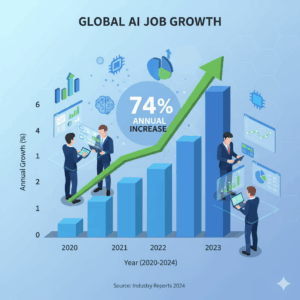
Artificial intelligence is transforming how businesses operate, innovate, and scale. As adoption accelerates, the demand for AI professionals has exploded, yet many companies still struggle to distinguish between core roles like AI consultants, AI engineers, and AI experts. According to LinkedIn, demand for AI-related roles has surged by nearly 74% annually since 2020, with businesses ranging from innovative startups to global enterprises seeking diverse AI skills. To build high-impact, sustainable AI solutions, it’s vital for organizations to understand these differences and choose the right talent for their needs.
An AI consultant bridges the gap between emerging AI technology and practical business value. These professionals advise organizations on when, where, and how AI can be used to solve real business challenges.
Key responsibilities include:
Skills & Expertise: AI consultants excel at turning business problems into AI opportunities. They combine strong business acumen, project management, data analytics, and a working knowledge of AI tools and techniques. While they may not code advanced models themselves, they must understand approaches like machine learning, NLP, or computer vision to drive effective collaboration with technical teams.
Industries hiring AI consultants include financial services, healthcare, retail, and manufacturing, sectors where data-driven transformation delivers outsized results. For example, a retail AI consultant might help deploy machine learning for demand forecasting, while a healthcare consultant could guide AI integration into patient care systems.

An AI engineer is the technical backbone of any AI initiative. These professionals design, build, and deploy AI-powered systems ranging from chatbots and recommendation engines to advanced automation tools.
Key responsibilities include:
Skills & Expertise: AI engineers are fluent in multiple programming languages (primarily Python), data structures, algorithms, and cloud platforms. They’re problem-solvers, able to tune models, optimize performance, and troubleshoot complex issues to deliver production-ready solutions.
Example Projects: AI engineers build personalized recommendation systems for streaming apps, design intelligent virtual assistants, or create computer vision solutions for automated quality inspection in manufacturing.
According to Gartner, by 2026, 80% of enterprises will use AI APIs or pre-built models, driving demand for engineers who can adapt and deploy these solutions. The global average salary for AI engineers now exceeds $120,000 per year, reflecting their critical role in bringing AI from concept to reality.

The term AI expert is broader, encompassing deep technical mastery, strategic insight, or rare specialization. AI experts often serve as lead researchers, senior consultants, trusted advisors, or specialists with advanced skills in fields like generative AI, natural language processing, or large-scale deployment.
Key responsibilities include:
Industries: Enterprises, government agencies, and research labs seek AI experts to lead programs, set standards, or navigate regulatory and ethical issues.
An AI expert might architect a multinational bank’s AI-powered fraud detection pipeline, lead R&D for medical imaging, or advise on scaling secure AI infrastructure for a global enterprise.
| Role | Primary Focus | Skillset | Outcomes | Common Industries |
| AI Consultant | Strategy & Adoption | Business acumen, AI literacy, project management | AI roadmaps, use case selection, ROI analysis | Finance, retail, healthcare, manufacturing |
| AI Engineer | Technical Implementation | Programming, ML, data science, cloud | Model development, deployment, system integration | SaaS, media, tech, logistics |
| AI Expert | Deep Technical & Strategic Mastery | Research, advanced AI/ML, leadership | End-to-end AI solutions, R&D, mentoring | Enterprise, R&D, consulting, academia |
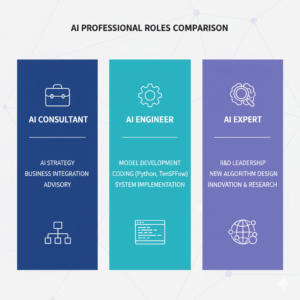
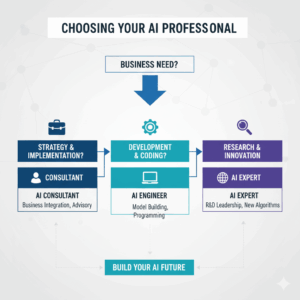
An AI consultant focuses on AI strategy, business alignment, and change management, whereas an AI engineer is a technical specialist who develops and deploys AI models and platforms.
Startups often benefit from hiring AI engineers for building AI features, but may seek AI experts or consultants for architectural guidance, vendor selection, or scaling as they grow.
Key skills: strategic planning, business analysis, AI technology literacy, communication, and experience delivering AI projects in relevant industries.
AI engineers typically earn $90,000–$150,000 annually worldwide; freelance/project rates can exceed $60–$120/hour based on experience and domain.
Not always. AI researchers typically focus on innovation and original research, while AI experts may combine research, consulting, engineering, and advisory roles.
Industries with high data availability and automation potential: finance, healthcare, e-commerce, manufacturing, logistics, and media.
In small teams, hybrid profiles are common. For large or complex initiatives, it’s more effective to collaborate across specialized roles.
Assess if you need a strategy (consultant), technical build (engineer), or holistic/advanced guidance (expert). Consider scope, budget, and stage of your AI journey.

Why Take Up Gigs/Part-time Jobs Alongside Your Full-time Job? The job market is constantly changing and evolving. People are prioritizing their financial stability and independence over everything. The previous culture of hustling and putting in more and more hours every…

Prompt engineering for business is the practice of designing, testing and improving the instructions, context and output formats given to an AI model so it performs a specific business task reliably. A prompt engineer defines what the model should do,…

What skills does a generative AI developer need? In short: solid Python programming, experience with large language model (LLM) APIs, retrieval systems such as RAG, the ability to build AI agents and tool integrations, and the discipline to test and…

A Java developer can build the software that runs behind many business systems: web applications, APIs, enterprise platforms, e-commerce backends, and microservices. If you are planning a project and wondering whether Java fits, this guide explains what Java is used…