

In 2025, companies aren’t just adopting AI; they are racing to make it reliable, accurate, and efficient. Simply having access to powerful generative AI models like GPT-4 or Claude isn’t enough; businesses need experts who know the AI’s language to unlock its full potential. This is why forward-thinking organizations hire prompt engineers to bridge the gap between human intent and machine output.
Prompt engineers are the architects of AI interaction. They refine inputs to ensure outputs are precise, relevant, and free from errors like hallucinations. The impact is measurable: Over 60% of companies adopting generative AI reported improved productivity when leveraging dedicated prompt engineering expertise. By optimizing how AI interprets instructions, these professionals turn raw computational power into a dependable business asset, ensuring that AI-driven workflows deliver consistent value rather than unpredictable results.
As AI integration deepens across industries, the “plug-and-play” approach to large language models (LLMs) is proving insufficient for enterprise needs. Businesses hire prompt engineers to transform generic AI capabilities into specialized, high-performance tools tailored to specific business contexts.
AI models are powerful but prone to ambiguity. Without precise instructions, they can produce vague, generic, or factually incorrect responses. A prompt engineer’s role is to design structured prompts that guide the AI through complex reasoning processes. Research indicates that optimizing prompts can increase response accuracy by up to 40% in specific tasks, significantly reducing the error rate in critical business applications.
By employing techniques like Chain-of-Thought (CoT) reasoning,where the model is instructed to “think” step-by-step, prompt engineers force the AI to validate its logic before generating an answer. This drastically improves reliability in fields requiring high precision, such as finance, legal analysis, and technical coding.
Finding the right talent is crucial. When you look for prompt engineers for hire, prioritize these key skills:
The difference between a standard AI user and a professional prompt engineer is the difference between a rough draft and a polished final product. Professional AI prompt engineering systematically elevates the quality of generative AI outputs.
Prompt engineers use sophisticated methods to refine AI performance:
One of the biggest risks in enterprise AI is “hallucination”, when an AI confidently states false information. Prompt engineers are critical in mitigating this. By implementing verification loops (asking the AI to critique its own answer) and uncertainty prompts (instructing the AI to admit when it doesn’t know the answer), experts can reduce hallucination rates significantly. Studies show that structured prompts like Chain-of-Thought can reduce hallucination rates from 38.3% to just 18.1%, making AI safe for professional use.
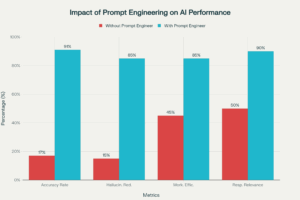
Beyond accuracy, hiring prompt engineers drives massive efficiency gains. They automate complex cognitive workflows that previously required human intervention.
According to PWC’s 2025 Global AI Jobs Barometer, workers with AI skills command a 56% wage premium, reflecting the immense value they bring in efficiency and productivity.
In the rapidly evolving AI landscape, the quality of your inputs determines the quality of your outcomes. Businesses that hire prompt engineers gain a decisive competitive advantage: reliable AI systems, automated high-value workflows, and significantly reduced operational risks. These experts turn generative AI from a novelty into a robust enterprise tool.
To stay ahead in 2025, investing in prompt engineering isn’t optional; it’s essential. Connect with top-tier prompt engineering talent today through Workflexi and transform your AI capabilities from potential to performance.
A prompt engineer designs, tests, and refines text inputs (prompts) for generative AI models. Their goal is to ensure the AI produces accurate, high-quality, and relevant outputs while minimizing errors and hallucinations.
Hiring prompt engineers allows businesses to maximize the ROI of their AI investments. These experts improve AI accuracy, automate complex workflows, reduce operational costs, and ensure that AI outputs align with brand standards and business goals.
They use advanced techniques like Chain-of-Thought reasoning, few-shot prompting, and iterative testing. These methods guide the AI’s logic, forcing it to validate its answers and stick to factual data, thereby significantly boosting precision.
Look for strong linguistic skills, analytical problem-solving, experience with LLMs (like GPT-4 or Claude), knowledge of data analysis, and familiarity with programming concepts (Python is often a plus).
Yes, significantly. By using techniques like verification prompts and grounding AI responses in specific data sources (RAG), prompt engineers can reduce hallucination rates by over 50%, making AI safer for business use.
Software development, marketing, customer support, legal services, and healthcare benefit most. Any industry relying on accurate text generation, code creation, or complex data summarization sees immediate value.
While prompt engineers command competitive salaries due to high demand, the return on investment is substantial. Their work automates tasks that would otherwise require multiple full-time employees, resulting in long-term cost savings.
They create reusable prompt libraries that automate repetitive cognitive tasks. This allows teams to complete work like report generation, coding, or content creation in a fraction of the time it would manually take.

Why Take Up Gigs/Part-time Jobs Alongside Your Full-time Job? The job market is constantly changing and evolving. People are prioritizing their financial stability and independence over everything. The previous culture of hustling and putting in more and more hours every…

Prompt engineering for business is the practice of designing, testing and improving the instructions, context and output formats given to an AI model so it performs a specific business task reliably. A prompt engineer defines what the model should do,…

What skills does a generative AI developer need? In short: solid Python programming, experience with large language model (LLM) APIs, retrieval systems such as RAG, the ability to build AI agents and tool integrations, and the discipline to test and…

A Java developer can build the software that runs behind many business systems: web applications, APIs, enterprise platforms, e-commerce backends, and microservices. If you are planning a project and wondering whether Java fits, this guide explains what Java is used…