

Data scientist experts use AI and Big Data to collect, clean, and analyze massive datasets. They build machine learning models, find patterns, and turn raw numbers into smart business decisions helping companies save money, grow faster, and stay ahead of the competition.
A data scientist is a professional who finds meaning in data.
They are part analyst, part programmer, and part storyteller. They take large, messy datasets and turn them into clear insights. These insights help businesses make smarter choices.
Think of it this way. Imagine you run an e-commerce store. You have millions of customer records. But what does all that data actually mean? A data scientist expert figures that out. They tell you which products are trending, which customers are likely to leave, and which marketing campaigns are worth your money.
According to the U.S. Bureau of Labor Statistics, data science jobs are expected to grow by 35% between 2022 and 2032. That’s one of the fastest growth rates of any profession. And it’s no surprise, every company today is sitting on mountains of data. They just need the right expert to make sense of it.
Here’s a simple breakdown of their day-to-day work:
AI is the most powerful tool in a data scientist’s kit.
Here’s how they use it in practice:
Data scientists build machine learning (ML) models that learn from data. Instead of writing rules manually, the model figures out patterns on its own.
For example, Netflix uses ML models to recommend shows. The model studies what you’ve watched, how long you watched, and what similar users enjoyed. Then it suggests something you’ll probably love. That’s AI working silently in the background.
NLP helps computers understand human language. Data scientists use NLP to analyze customer reviews, support tickets, and social media posts.
A retail company, for instance, can use NLP to scan thousands of product reviews automatically. The system flags negative feedback, identifies common complaints, and helps the team respond faster.
AI can now “see” images and videos. Data scientists train computer vision models to detect objects, recognize faces, and even spot defects in manufacturing.
Amazon uses computer vision in its Go stores. There are no cashiers. The AI tracks what you pick up and charges you automatically when you leave.
This is where AI gets really exciting for businesses.
Data scientists build models that predict future behavior. Will this customer churn? Will this machine fail next week? Which loan applicant is a credit risk? Predictive analytics answers these questions before problems happen.
Big Data is exactly what it sounds like: data so large and complex that traditional tools can’t handle it.
We’re talking about terabytes and petabytes of information generated every second. Social media posts. IoT sensor readings. Transaction records. Website clicks. All of it flowing in real time.
Data scientists use specialized tools and platforms to manage this scale.
Here are the most common tools data scientists use:
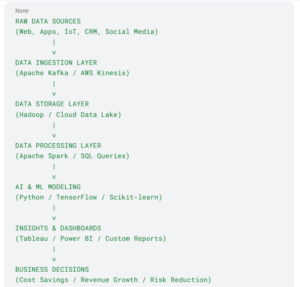
Hiring a data scientist expert isn’t just a tech decision. It’s a business investment with measurable returns.
Here’s what companies typically gain:
Cost Reduction: AI-powered predictive maintenance can reduce equipment downtime by up to 50%, according to McKinsey. One sensor failure caught early can save hundreds of thousands in repair costs.
Revenue Growth: Personalized recommendations (powered by data science) drive 35% of Amazon’s total revenue. Data-driven personalization simply sells more.
Better Customer Retention: Companies using predictive churn models reduce customer loss by 15–25%. Knowing who’s about to leave before they do lets you act fast.
Faster Decision-Making: Businesses that rely on data-driven decisions are 23 times more likely to acquire customers and 6 times more likely to retain them, according to McKinsey Global Institute.
Fraud Prevention: Banks and fintech companies save billions annually using AI fraud detection models built by data scientists. The ROI is real. And it compounds over time as models get smarter.
The field is evolving fast. Here’s where it’s heading:
Generative AI Integration: Data scientists are now combining traditional ML with large language models (LLMs) like GPT to build smarter, more conversational data products.
AutoML: Automated machine learning tools are making it easier to build models faster. But human experts are still needed to validate, interpret, and deploy them responsibly.
Edge AI: AI models are moving closer to the data source (think: smart devices, factory floors). Data scientists are learning to build lightweight models that run without cloud connectivity.
Responsible AI & Explainability: As AI gets used in hiring, lending, and healthcare, companies need data scientists who can explain model decisions clearly and ensure fairness.
Real-Time AI Pipelines: The demand for instant insights is rising. Streaming analytics and real-time ML inference are becoming standard practice.
Finding the right data scientist expert is not easy. The talent pool is competitive. The skill requirements are specific. And the hiring process takes time. That’s where Workflexi comes in.
Workflexi connects businesses with pre-vetted, experienced data science professionals — on a flexible, project-based, or full-time basis. Whether you need someone to build your first ML pipeline or scale an existing AI product, we have the right talent ready.
A data scientist expert collects, cleans, and analyzes large datasets. They build AI and machine learning models to find patterns and help businesses make smarter, data-driven decisions.
Data scientists use AI to build predictive models, automate pattern recognition, process natural language, and generate real-time insights from large volumes of data.
Big Data refers to extremely large and complex datasets that can’t be processed with traditional tools. Data scientists use specialized platforms like Apache Spark and Hadoop to analyze this data and extract valuable business insights.
Common tools include Python, R, Apache Spark, Hadoop, SQL, TensorFlow, Tableau, Power BI, and cloud platforms like AWS and Google BigQuery.
Hiring a data scientist can help your business reduce costs, increase revenue through personalization, improve customer retention, detect fraud, and make faster, smarter decisions backed by real data.
A data analyst focuses on historical data and reporting. A data scientist builds predictive models using AI and machine learning, going beyond past data to forecast future outcomes.
You can hire pre-vetted data scientist experts on Workflexi. We offer flexible engagement options — project-based, part-time, or full-time — so you can find the right fit for your business needs.

Why Take Up Gigs/Part-time Jobs Alongside Your Full-time Job? The job market is constantly changing and evolving. People are prioritizing their financial stability and independence over everything. The previous culture of hustling and putting in more and more hours every…

A prompt engineer expert should understand prompt design, context management, output formatting, testing and evaluation, task decomposition, and the limitations of different AI models. They should also know basic API and tool-calling concepts so prompts can be used in automated…

A machine learning expert should know Python, core statistics, machine learning algorithms, data preparation, and model evaluation. Framework knowledge TensorFlow, PyTorch, or Scikit-learn depends on whether the project needs deep learning or simpler, structured-data models. No single tool defines expertise;…

AI is changing freelance data analyst work by automating repetitive tasks like data cleaning, SQL query writing, and first-draft reporting, while increasing the value of skills AI can't easily replicate business context, data validation, and client communication. AI is unlikely…