
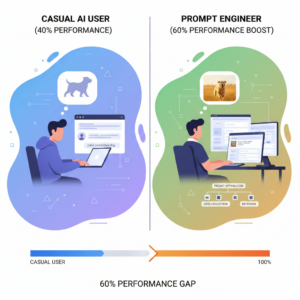
Yes, but only if you want to maximize the value you’re already getting from AI. Most companies using tools like ChatGPT, Claude, or Gemini are leaving 40-60% of potential value on the table. While basic AI tools work adequately for casual use, hiring prompt engineers transforms generic AI outputs into specialized, business-critical assets. The difference is like owning a high-performance car but only driving it in first gear; the capability exists, but expertise is required to unlock it.
This guide explains when prompt engineers matter, what they actually do, and whether your organization needs one.
Most companies use AI tools reactively. A marketer pastes a request into ChatGPT and accepts whatever emerges. A developer uses GitHub Copilot for quick code suggestions. A customer support team deploys a chatbot with default settings. These approaches work; AI tools are genuinely useful, but they deliver baseline performance.
Prompt engineers operate differently. They systematically refine how humans communicate with AI, creating structured approaches that consistently extract superior outputs. Research shows that optimized prompts improve response accuracy by 40-60% compared to casual AI usage. For business applications, this gap translates directly to productivity, quality, and reliability.
Think of it this way: Anyone can operate a microscope, but it takes training to get meaningful scientific results. Similarly, anyone can use ChatGPT, but extracting optimal business value requires specialized expertise.
Prompt engineers aren’t just “people who write better questions for AI.” Their work is systematic and technical:
Designing Prompt Structures: They create templates and frameworks that guide AI through complex reasoning. Techniques like Chain-of-Thought prompting—instructing AI to “think step-by-step”- reduce error rates by up to 50% in analytical tasks.
Testing and Optimization: They run dozens of prompt variations against standardized datasets, measuring which approaches yield the highest-quality outputs. This scientific approach replaces guesswork.
Handling Context and Constraints: They embed business rules, data references, and output format requirements directly into prompts, ensuring AI generates precisely what you need rather than generic responses.
Reducing Hallucinations: By implementing verification loops and confidence signals, prompt engineers dramatically decrease instances where AI confidently states false information—a critical concern for regulated industries.
Customizing Tone and Style: For content generation, they ensure AI maintains brand voice, appropriate formality levels, and industry-specific terminology.
This isn’t magic—it’s methodology. Companies that implement these practices systematically outperform those using AI tools casually.

If your organization generates dozens of pieces daily, marketing copy, social media posts, product descriptions, prompt engineers create reusable templates that maintain consistency while reducing production time by 30-50%.
Industry Example: An e-commerce company with 50,000 SKUs needs product descriptions. Basic AI usage produces mediocre results requiring heavy editing. A prompt engineer designs a structured prompt incorporating brand voice, SEO requirements, and feature priorities. The same prompt then generates thousands of optimized descriptions with minimal revision.
Healthcare, finance, and legal contexts demand high accuracy, where AI hallucinations carry serious consequences. Prompt engineers implement verification systems and grounding techniques that make AI safe for professional use.
Industry Example: A financial advisory firm uses AI for client portfolio analysis. Without prompt engineering, the system occasionally generates misleading analysis. With optimized prompts grounding AI in verified market data, it becomes a reliable decision-support tool.
When problems require multi-step logic, market analysis, code debugging, research synthesis, prompt engineers use advanced techniques like Chain-of-Thought that dramatically improve reasoning quality.
Compliance, audit trails, and explainability requirements often demand prompt engineers who understand how to structure AI systems for regulatory scrutiny.
Better Accuracy: Scientific prompt optimization consistently outperforms casual usage, with improvements ranging from 15-40% depending on task complexity.
Cost Reduction: By automating previously manual cognitive work more reliably, companies reduce operational expenses—often recovering prompt engineer salaries within weeks.
Risk Mitigation: Reduced hallucinations and improved accuracy prevent costly errors in customer-facing applications or analytical systems, informing decisions.
Scalability: Reusable prompt templates enable teams to scale AI usage without proportional increases in manual oversight.
You probably don’t need a dedicated prompt engineer if:
You definitely should hire a prompt engineer if:
For most growing businesses with meaningful AI usage, hiring a prompt engineer provides clear ROI within 2-3 months.
Prompt engineers aren’t necessary if you’re happy with baseline AI performance. They’re essential if you want to extract full value from the AI tools you’re already investing in. Given that most organizations leave 40-60% of potential AI value unrealized, prompt engineering expertise typically delivers strong returns.
Ready to unlock your AI potential with expert guidance? Workflexi connects organizations with skilled, prompt engineers and AI specialists who understand how to transform raw AI capability into business advantage. Whether you need a prompt engineer to optimize existing tools or broader AI consulting, our network includes professionals ready to accelerate your AI transformation. Visit Workflexi today to explore AI talent that drives real business impact.
Prompt engineers systematically design, test, and refine how you communicate with AI. They use techniques like Chain-of-Thought reasoning, few-shot prompting, and verification loops—approaches that consistently improve accuracy by 40-60% compared to casual usage.
Dedicated prompt engineers work best for organizations with high AI usage volume. Smaller companies might start with hiring a specialist for a few hours weekly to design core prompts that teams then use repeatedly.
Organizations typically see 25-40% productivity gains through reduced revision cycles, faster time-to-usable output, and decreased hallucinations. ROI timelines are usually 2-3 months.
Freelance prompt engineers typically charge $50-$150/hour, while salaries for full-time specialists range from $90,000-$150,000 annually depending on experience and location. The investment often pays for itself quickly through efficiency gains.
Yes, significantly. Through grounding AI in verified data, implementing verification loops, and using confidence signals, prompt engineers can reduce hallucination rates from 25-35% down to 3-8%—making AI safe for mission-critical applications.
Healthcare, finance, legal services, and regulated industries see the strongest benefits because accuracy and compliance matter most. However, any organization with high-volume AI usage benefits from prompt engineering expertise.
Prompt engineering skills will remain valuable. As AI becomes more sophisticated, the ability to effectively communicate with these systems will become increasingly important across business functions—similar to how digital literacy became universally expected.
Why Take Up Gigs/Part-time Jobs Alongside Your Full-time Job? The job market is constantly changing and evolving. People are prioritizing their financial stability and independence over everything. The previous culture of hustling and putting in more and more hours every…

A prompt engineer expert should understand prompt design, context management, output formatting, testing and evaluation, task decomposition, and the limitations of different AI models. They should also know basic API and tool-calling concepts so prompts can be used in automated…

A machine learning expert should know Python, core statistics, machine learning algorithms, data preparation, and model evaluation. Framework knowledge TensorFlow, PyTorch, or Scikit-learn depends on whether the project needs deep learning or simpler, structured-data models. No single tool defines expertise;…

AI is changing freelance data analyst work by automating repetitive tasks like data cleaning, SQL query writing, and first-draft reporting, while increasing the value of skills AI can't easily replicate business context, data validation, and client communication. AI is unlikely…